A practical Catholic handbook
A medal around your neck. A scapular under your shirt. A bottle of holy water at home.
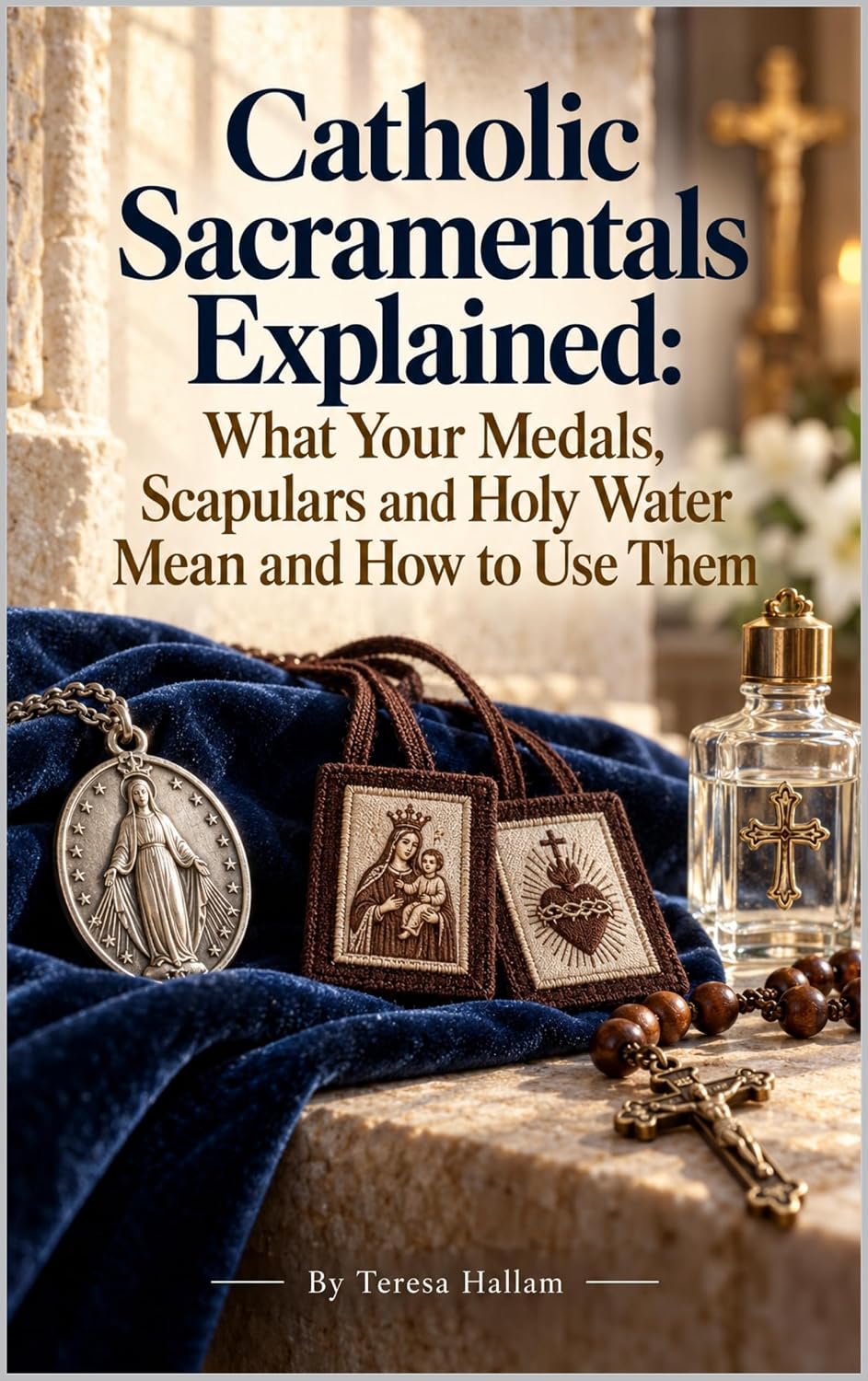
Catholic Sacramentals Explained: What Your Medals, Scapulars and Holy Water Mean and How to Use Them
by Teresa Hallam
What do these objects mean, and how do you use them without treating them as charms? Teresa Hallam connects familiar devotional objects with prayer, responsible conduct and trust in God, in a guide you can read from beginning to end or consult when a particular object raises a question.
Published November 10, 2026ASIN B0HR4L24HM
Inside the handbook
What this book explores
Six areas, each treated as a question a reader actually asks rather than a list to be memorised. The thread through all of them is the same: these are signs that serve faith.
Foundations
Sacraments and sacramentals
The distinction the book starts from: sacramentals are aids to faith, not objects with independent power, and they do not replace the sacraments.
Read moreBlessings
Blessing people, places, objects and activities
How the Church blesses, what a blessing asks of God, and why a blessed home can still know grief while a blessed car still needs a careful driver.
Read moreWater
Holy water
Its meaning and everyday use, with practical attention to clean storage, contamination, clear labelling and respect for another person’s consent.
Read moreMetal and cloth
Medals and scapulars
The Miraculous, Saint Christopher and Saint Benedict Medals; the Brown and Green Scapulars; and the line between a devotional reminder and a supposed guarantee.
Read moreAt home
Household devotion
Crucifixes, blessed salt, candles, holy cards, icons and statues, alongside prayer corners, house blessings and car blessings.
Read moreThrough the year
The Church year
Epiphany chalk, Candlemas, Saint Blaise’s blessing, ashes, palms, Easter water, the Advent wreath and the Nativity scene.
Read more
The approach
Devotion, without superstition
The book begins with a distinction that shapes everything after it: sacramentals are aids to faith. From there it stays concrete, because the objects themselves are concrete.
- 01
It answers the question you actually have
Read it straight through, or turn to the object in front of you. The structure follows ordinary situations: a scapular found in a drawer, a medal inherited from a grandparent, a bottle of holy water nobody is sure how to store.
- 02
It keeps prayer and responsibility together
Candle use is paired with fire precautions and flameless alternatives. Car blessings are linked with seat belts, maintenance and safely secured reminders. A household practice before a crucifix brings together thanksgiving, petition and forgiveness, and leads toward reconciliation and charity.
- 03
It names the confusion instead of avoiding it
Did Saint Christopher cease to be a saint when his memorial left the universal calendar? Can a medal take the place of medical treatment or pastoral support? The book separates what devotion means from what it cannot promise.
- 04
It covers the end of an object’s life, not just the start
Gifts, thoughtful buying, blessings and retiring sacramentals are all treated, so a worn or broken object does not leave a reader guessing.
Readers
Who it is for
This is a handbook for adults who already live with these objects, or who are about to. It is not a children’s book, a clinical or medical resource, or a substitute for pastoral, medical or professional advice.
- Catholics who have inherited medals, a scapular or a crucifix and want to know what they are and what to do with them.
- Converts and returning Catholics meeting devotional customs for the first time and wanting an honest explanation.
- Parents, godparents and sponsors choosing a religious gift and wanting it to mean something accurate.
- Readers arranging a prayer space at home, or wondering how a house blessing fits with ordinary household life.
- Anyone who has heard a claim about a medal or scapular that sounded more like a charm than a sign of faith.
Short answers first
Reader questions
Eight questions readers bring to this subject, answered briefly here and at more length in the guides. Where Church teaching is the source, it is named; where the handbook is the source, that is said too.
- What makes a sacramental different from a charm?
- A charm is treated as if it worked on its own. A sacramental is a sacred sign used in faith, and its effect is asked of God through the prayer of the Church. The book states the difference plainly: sacramentals are aids to faith, not objects with independent power.
- Why does holy water recall Baptism?
- The Catechism describes the sprinkling of holy water as a sign that recalls Baptism (CCC 1668). Water is the matter of baptismal washing, so blessing ourselves with it is a small return to the beginning of the Christian life rather than a separate ritual with power of its own.
- Does a Brown Scapular guarantee salvation?
- No. The book treats such claims as a misunderstanding and sets the scapular where it belongs: a sign of repentance, perseverance and belonging, worn with respect for conscience. A piece of cloth does not replace faith, sacramental life or charity.
- Saint Benedict Medal vs Miraculous Medal: what is the difference?
- They are different devotional objects with different imagery and histories: one associated with Saint Benedict, one with the apparitions remembered at the Rue du Bac. The handbook presents them as reminders of faith, not as ranked sources of protection.
- Did Saint Christopher stop being a saint?
- Removal from the universal calendar is not a declaration that someone is not a saint. The 1969 revision of the Roman calendar left many saints to local calendars and regions; the book uses the question to separate calendar changes from claims about holiness.
- What does a Catholic house blessing mean?
- It is prayer, not a guarantee against hardship. A blessing asks God’s help for the people who live there and for the life they share. The book keeps that alongside the ordinary work of a household rather than in place of it.
- How do Epiphany chalk and Candlemas candles differ?
- They belong to different moments in the Church year. Epiphany chalk is connected with the Christmas season and the marking of homes; Candlemas candles belong to the Presentation of the Lord. The book explains both as seasonal customs, not as formulas with guaranteed effects.
- Can a blessed car still have an accident?
- Yes. A blessing is not a safety guarantee. The book pairs car blessings with seat belts, maintenance and securely fixed devotional reminders, because prayer belongs alongside care and responsibility, not in place of them.
The book
Book and author details
Only verified details are listed here. For current price, format and availability, open the listing itself.
- Title
- Catholic Sacramentals Explained: What Your Medals, Scapulars and Holy Water Mean and How to Use Them
- Author
- Teresa Hallam
- Publication date
- November 10, 2026
- ASIN
- B0HR4L24HM
- Subject
- Catholic sacramentals and devotional practice
The author
Teresa Hallam
Teresa Hallam wrote this handbook for readers who want the objects of Catholic devotion explained rather than merely described. Beyond the author name on the cover, this site does not add biographical claims that the book’s own listing does not support.
The guide is organised so that it can be read in sequence or consulted by topic. Its reference resources include a year of sacramentals and blessings, as described in the listing.
The whole point
Understand the objects, and the faith they are meant to serve.
If you own a medal you cannot explain, a scapular you are unsure how to wear, or holy water you are not sure how to keep, this is a book written for that exact situation.
- Sacraments and sacramentalsSacraments vs sacramentals: what is the difference?
- Holy water at homeHow do you use holy water at home?
- Catholic medal meaningsWhat do Catholic medals mean?
- Brown Scapular meaningWhat does the Brown Scapular mean?
- Prayer corners and house blessingsHow do you set up a Catholic prayer corner?
- Epiphany chalk and CandlemasHow do Epiphany chalk and Candlemas candles differ?
- Retiring blessed objectsHow do you dispose of blessed objects?
- Catholic sacramentals as giftsHow do you choose a Catholic sacramental gift?